
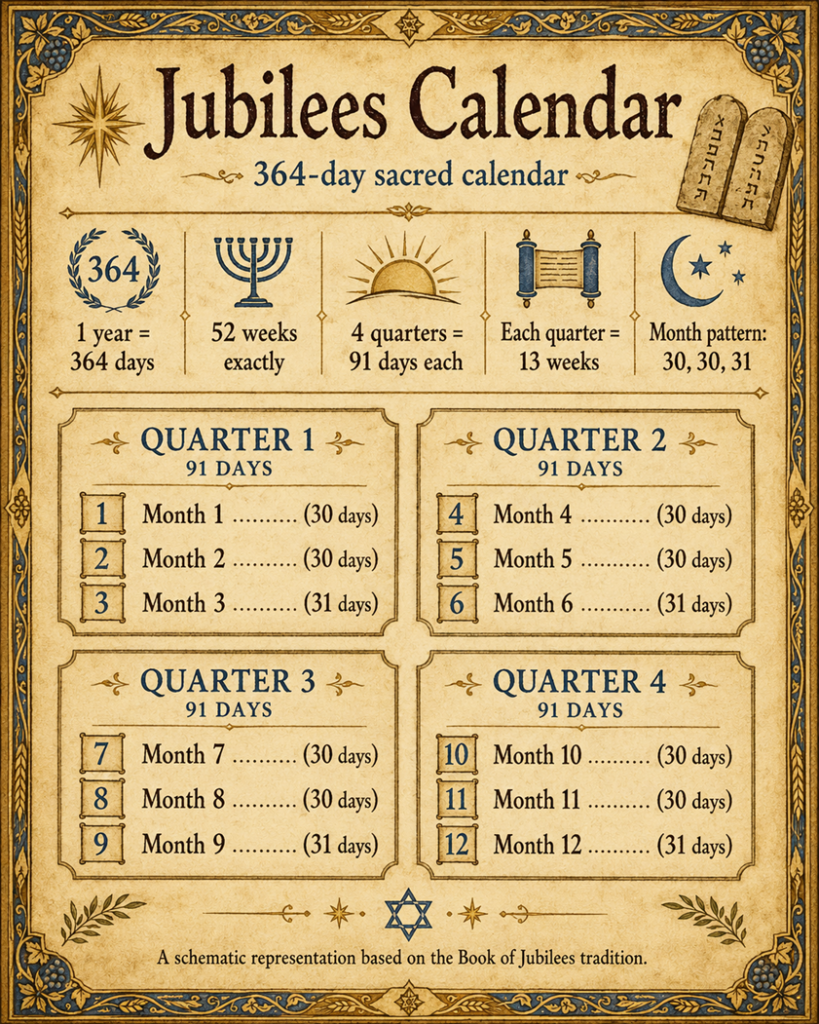
The calendar in the Book of Jubilees is a 364-day sacred calendar.
It is not mainly a normal farming calendar or a modern calendar. Jubilees presents it as a God-given calendar, written on the heavenly tablets and revealed to Moses so Israel would keep the feasts, Sabbaths, seasons, and jubilees correctly. Jubilees 6 says the year should be counted as 364 days, so the festivals do not get moved around. (pseudepigrapha.com)
That matters because 364 divides perfectly by 7. So every year has exactly 52 full weeks. That means holy days would fall on the same day of the week every year instead of shifting around. TheTorah.com explains that this is one reason the calendar was useful: every date stays anchored to a fixed weekday. (The Torah)
Jubilees also argues against using the moon to set the calendar. It says people who follow the moon will get the seasons wrong, because the lunar calendar is shorter and comes in about ten days too soon each year. In Jubilees, that is serious because the wrong calendar means the wrong feast days, wrong Sabbaths, and wrong sacred seasons. (pseudepigrapha.com)
So, in plain English:
The calendar in Jubilees is a fixed solar-style sacred calendar of 364 days, built around weeks, Sabbaths, feasts, seasons, and covenant order. It is trying to say that God’s time is orderly, exact, and holy, and that Israel should not let human error or moon-based calculations disturb God’s appointed days.
If the Book of Jubilees is preserved in the Ethiopian Orthodox Bible, and it talks about a 364-day sacred calendar, then why aren’t Christians using that calendar?
The honest answer is: because the Church preserved Jubilees, but most churches did not make the Jubilees calendar the official worship calendar.
Here is the plain explanation.
1. Jubilees is in the Ethiopian Bible, but not in most Christian Bibles
The Ethiopian Orthodox Church lists Jubilees as part of its Old Testament canon, and its Bible has 81 books, more than the Protestant, Catholic, or most Eastern Orthodox Bibles. (Ethiopian Orthodox Tewahedo Church)
But most Christians never had Jubilees in their Bible. So for most churches, the calendar in Jubilees never became their calendar.
2. Even Ethiopia does not use a 364-day Jubilees calendar today
This is the part that matters most. The Ethiopian Orthodox Church has Jubilees, but the actual Ethiopian church calendar is not 364 days. The Ethiopian Orthodox calendar has 365 days, with an extra day added every fourth year, and it came through the Egyptian/Coptic calendar tradition. (Ethiopian Orthodox Tewahedo Church)
So even the church that preserved Jubilees did not end up using the exact Jubilees calendar as its everyday church calendar.
3. The Jubilees calendar is beautiful, but hard to use without extra rules
Jubilees teaches a 364-day year, which equals 52 exact weeks. That makes everything neat: the feasts always fall on the same weekday. Scholars describe the Jubilees calendar as a solar calendar with 364 days. (TheTorah.com)
But there is a problem. A real solar year is about 365.24 days, not 364. So a strict 364-day calendar would slowly drift away from the seasons unless you add correction days or leap weeks. Jubilees strongly defends the 364-day system, but it does not give one clear, universally accepted modern method for fixing that drift.
That is why modern people who try to follow it often disagree on when the year begins.
4. The Jewish calendar went a different direction
Mainstream Judaism uses a lunisolar calendar, meaning the months follow the moon, but leap months are added so the holy days stay in the right season. For example, Jewish sources explain that an extra month is added about every three years to keep Passover in the spring. (Chabad)
Jubilees argues against that kind of lunar-based system. So this was not just a calendar difference. It was a serious religious disagreement.
5. The early Church followed other inherited calendars
Christian churches eventually built their worship year around things like:
- Pascha/Easter
- Christmas
- Lent
- feast days
- saint days
- local church traditions
They did not build the Christian year directly from Jubilees. So the Jubilees calendar stayed more like an ancient sacred witness, not the ruling calendar of the Church.
My honest opinion
I think you are asking the right question. If a person believes Jubilees should be treated as Scripture, then the calendar question becomes serious.
But I would say it this way:
The Book of Jubilees gives us a vision of God’s ordered time, but the historical churches did not agree that its 364-day calendar had to replace the calendars already being used for worship.
So we are not using it mainly because of canon differences, church tradition, practical calendar problems, and historical habit.
The calendar in Jubilees was preserved, but not fully practiced. It remains like a buried witness, reminding us that time itself was once seen as holy, ordered, and accountable before God.